HSP101

A “Cheat Sheet” for all things Highly Sensitive
When I first learned I was highly sensitive, I did what most of us do — I went searching. I wanted answers, context, and most of all, I wanted to feel less alone in something I’d carried my whole life without a name for it.
Since then (I learned about the trait in 2011), I’ve been closely following the research as it’s released, and what’s out there is genuinely reassuring, validating, and worth knowing. So I compiled it all into one place — a clear, easy-to-read guide you can read right here or download and print to keep (or share).
This resource is for you if:
You’re highly sensitive and want the most up-to-date research about the trait
You just found out you’re an HSP and don’t know where to start
You think you might be highly sensitive, but aren’t sure yet
You want something concrete to share with a partner, family member, or friend who wants to understand you better
Wherever you are in your journey with this trait, consider this your starting point.
✨ Scroll down to download a
printable version to share with others! ✨
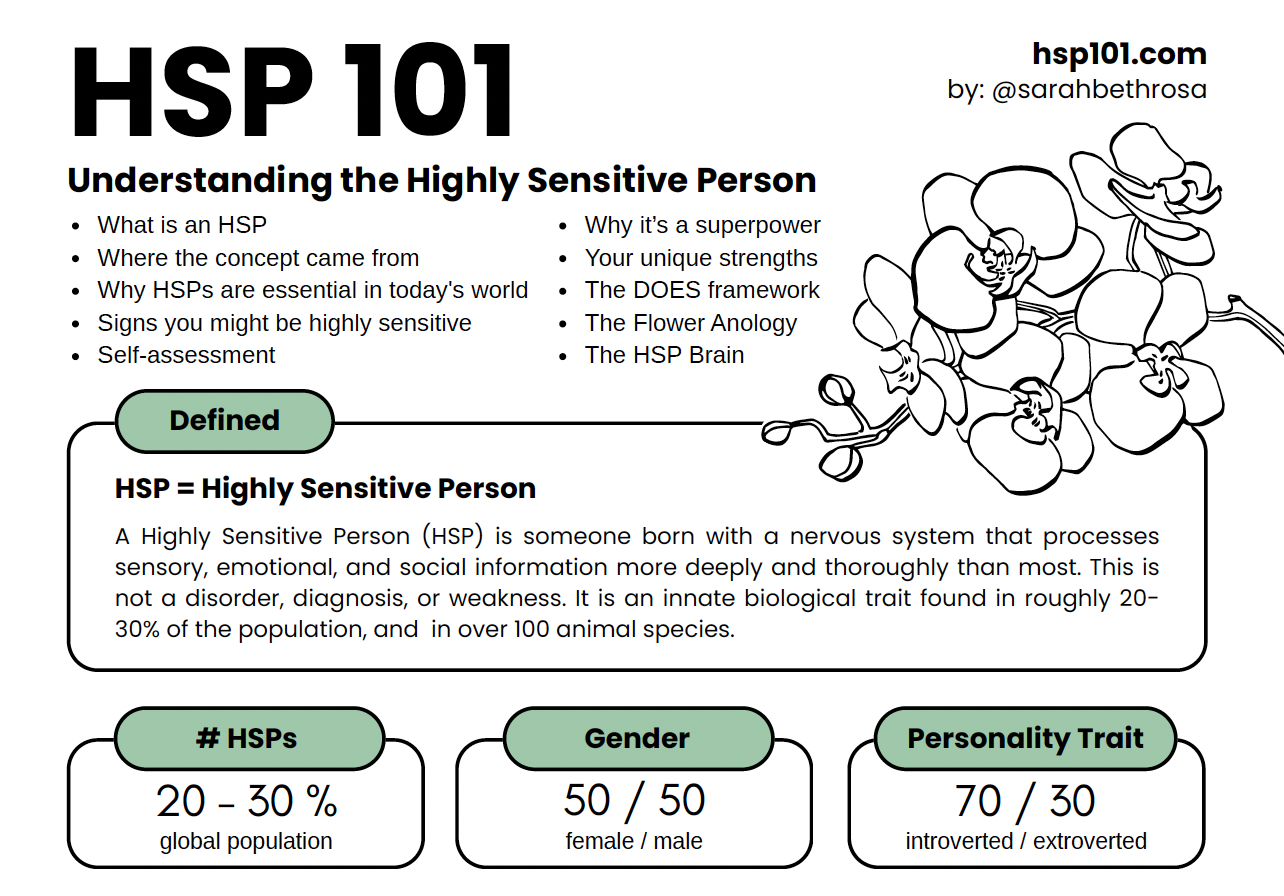
HSP = Highly Sensitive Person
Defined
A Highly Sensitive Person (HSP) is someone born with a nervous system that processes sensory, emotional, and social information more deeply and thoroughly than most. This is not a disorder, diagnosis, or weakness — it is an innate biological trait found in roughly 20-30% of the population, and in over 100 animal species.
History of High Sensitivity
History of High Sensitivity
The term “Highly Sensitive Person” was coined by psychologist and researcher Dr. Elaine Aron in the 1990s. In her 1996 book The Highly Sensitive Person, Aron introduced the concept after studying people who reported being easily overwhelmed by stimulation. Her research showed this trait, also known by its clinical term, Sensory Processing Sensitivity (SPS). Elaine continues to educate others about highly sensitive people today.
Learn more at hsperson.com.
HSPs are Needed in Society
Why HSPs are Needed in Society
Sensitivity isn’t a flaw. It’s a feature that humans have relied on for thousands of years. Highly sensitive people historically served as the scouts and advisors of their communities: noticing danger early, reading social dynamics carefully, and thinking deeply before acting. In modern life, HSPs bring:
Depth of processing that leads to nuanced, thoughtful decisions
Empathy and emotional attunement that strengthens relationships and teams
Creativity and pattern-recognition that drives innovation
Conscientious awareness that catches what others miss
You may be an HSP if…
8 Signs You Might Be An HSP
You feel deeply affected by others’ emotions or moods
Loud noises, bright lights, or strong smells are easily overwhelming
You need time alone to decompress after busy or stimulating environments
You notice subtleties — a change in someone’s tone, a small detail in a room
You think deeply before making decisions and reflect often
You are moved by art, music, or beauty in ways that feel profound
Criticism hits harder and stays longer than it seems to for others
You feel overwhelmed when there is too much to do in a short time
Strengths Highly Sensitive People
6 Strengths of being an HSP
Sensitivity is often framed as a liability. The reality? It comes with remarkable gifts when understood and honored.
💕 Deep Empathy You feel and understand others profoundly, making you an exceptional friend, partner, and leader.
🧠 Thoughtful Decisions You process information thoroughly before acting, an asset in complex situations.
👁️ Keen Awareness You notice what others miss: subtle shifts in mood, environment, or opportunity.
🌿 Conscientious Care Your depth of feeling fuels creativity, imagination, and artistic expression.
✨ Rich Inner Life You take your work, relationships, and responsibilities seriously and with great integrity.
🎨 Aesthetic Sensitivity You experience beauty deeply in nature, art, music, and everyday moments.
HSP Self-Test
Highly Sensitive Person Self-Test
Dr. Aron's official Highly Sensitive Person Self-Test consists of single-choice questions designed to help you identify whether you carry this trait. It takes about five minutes and is available for free at hsperson.com. There are also adapted versions for children and for assessing sensitivity in your relationships. Find all the tests here → hsperson.com/test.
Dr. Elaine Aron’s DOES Framework
The DOES Framework
Dr. Elaine Aron identified four core traits that define high sensitivity, captured in the acronym DOES:
Depth of Processing HSPs process information more deeply than others, noticing patterns, making connections, and thinking decisions through before acting.
Overstimulation Because they take in so much, HSPs reach their stimulation threshold faster and often need more downtime after social or sensory-heavy events.
Emotional Reactivity & Empathy HSPs feel emotions intensely, both positive and negative, and are deeply in tune with the feelings of those around them.
Sensing the Subtle HSPs notice slight changes in their environment (scents, sounds, light) or subtle social cues that others often miss.
Read more about DOES at hsperson.com/faq/evidence-for-does
The Flower Analogy
Orchids, Tulips, and Dandelions
Sensitivity lives on a spectrum, visualized through three flowers. The framework was developed by Dr. Thomas Boyce & Dr. Bruce Ellis (2005). Researcher Michael Pluess added the tulip in 2018. The key insight: sensitivity is not a flaw. It's a high-stakes trait with greater risk and greater potential depending on one's environment.
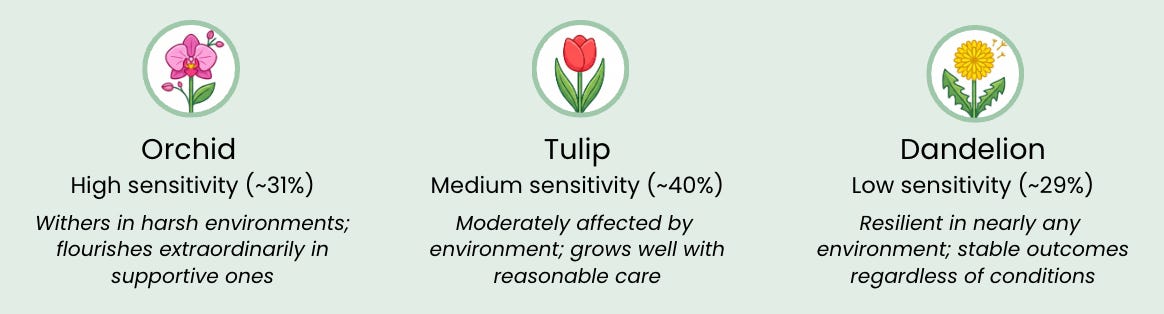
Source: Lionetti et al., 2018 via highlysensitiverefuge.com
When Overstimulation Occurs
When HSPs are Overstimulated
Knowing your triggers is the first step. When overstimulation hits, try these:
🚪 Exit & Reset Step away from the stimulus. Even 5 minutes alone helps
👁️ Ground Your Senses 5 things you can see, 4 you can feel, 3 you can hear, 2 you can smell, 1 you can taste
🫁 Slow Your Breath 4-count inhale, 6-count exhale to calm the nervous system
🔇 Reduce Input Lower noise, dim lights, put your phone away
🛡️ Prevent Where Possible Schedule downtime before burnout sets in. Recovery is essential for HSPs.
The HSP Brain
The HSP Brain
High sensitivity isn’t a mood or a choice. It’s neurological. HSP brains are structurally and functionally different in key areas:
🧠 Insula More active in HSPs, driving heightened awareness of internal states and external sensory detail.
⚡ Amygdala Reacts faster and more intensely to emotional stimuli, both positive and negative.
🪞 Mirror Neurons Fire more strongly, contributing to deep empathy. HSPs tend to absorb others’ emotions as their own.
💊 Dopamine & Serotonin Processed differently, making HSPs feel rewards and threats more acutely than non-HSPs.
🧬 Genetic makeup Research indicates sensitivity has a genetic origin, shaped by multiple genes working together rather than any single one. HSPs are born this way, not made.
*Genetic research is ongoing. For current findings, visit hsperson.com.
Advisors to the Kings
HSPs are the Advisors to the Kings
In her 1996 book, The Highly Sensitive Person: How to Thrive When the World Overwhelms You, Dr. Elaine Aron uses the "royal advisor" metaphor to describe the societal role of Highly Sensitive People. She contrasts them with the "warrior-king" class, those who are more prone to impulsive action and aggression, arguing that HSPs serve as the necessary counterbalance by emphasizing reflection, caution, and long-term consequences.
HSP Resources
Resources to Go Deeper
BOOK: The Highly Sensitive Person — Dr. Elaine Aron (1996)
BOOK: The Highly Sensitive Person’s Workbook - Dr. Elaine Aron (1999)
BOOK: sensitive - Jenn Granneman and Andre Sólo (2024)
BOOK: Quiet: The Power of Introverts — Susan Cain (also relevant for HSPs)
WEBSITE: hsperson.com — Dr. Aron’s official site, research & community
WEBSITE: highlysensitiverefuge.com — articles, tools & community
WEBSITE: hsp101.com — HSP fundamentals & starter resources
MOVIE: Sensitive: The Untold Story - documentary featuring Alanis Morissette
PODCAST: Sensitive Stories — April Snow
COMMUNITY: Sensitive Circles — April Snow
NOTE: Resources shown are a starting point — many more exist for
HSCs (children), relationships, and beyond.
Printable Resource
Download a printable version to share with others👇